Contributor Patricia Mugenzi
 Abidjan, 1 April 2026, 10:50 PM (UTC+0).
Today, the world is watching Artemis II, NASA’s first crewed mission toward the Moon since the Apollo era. Four astronauts are preparing for a ten-day journey that revives an old dream of lunar exploration.
But as this new chapter of space history unfolds, I find myself thinking about Africa. Not because Africa is absent from the global space conversation, but because its place in that conversation is changing.
In a world shaped by geopolitical tension, technological competition, satellite dependence, and growing rivalry over data and infrastructure, the real question is no longer whether Africa will participate in space, but how it will govern its interests there.
This matters because many African institutions still rely on external platforms such as Copernicus, NASA’s open datasets, Google Earth Engine, and commercial imagery providers. While these tools are immensely valuable, they also quietly shape who interprets data, who builds expertise, who owns the insights that follow, and who ultimately benefits from the knowledge produced. Like roads, electricity, or internet access, satellite connectivity is becoming basic infrastructure. And as with any infrastructure, the rules around who provides it can shape who benefits most. Dependence is never neutral. That is precisely why space governance matters.
The African Space Agency (AfSA) sits at the heart of that question. Formally inaugurated in April 2025, AfSA is not meant to become a continental version of NASA, racing toward prestige missions or symbolic technological victories. Its role is quieter, but arguably more strategic: to help coordinate Africa’s space ambitions, align policies, strengthen technical capacity, improve access to data, and build cooperation across a field that is still unevenly developed across the continent.
In that sense, AfSA represents something important. It is not just about joining the space age. It is about shaping the rules, partnerships, and institutions that will determine who benefits from it.
The future of African space governance may come down to three big balancing acts.
First, there is the question of how African countries can work together without losing too much control. That tension is already visible in satellite connectivity, where operators still face a fragmented regulatory environment rather than a truly coordinated continental market.
Second, there is the challenge of partnership without dependency. South Africa’s current debates around satellite internet regulation show how difficult it can be to balance domestic priorities, such as ownership and inclusion, with the need to attract global providers.
The planned changes to South Africa’s Electronic Communications Act directly address the current requirement for foreign-owned communications licensees to sell 30% of equity in their local subsidiaries to historically disadvantaged groups. (Gullapalli, 2025)
Third, there is the question of usefulness. For most African citizens, the value of space will not be measured by prestige alone, but by whether it improves everyday life.
In Nigeria, satellite-enabled health initiatives have helped extend services to remote communities and improve public health data. In Ghana, satellite-supported agricultural programmes (SAT4farming) have helped cocoa farmers improve productivity and incomes.
Together, these examples suggest that Africa’s space future will be judged by whether it delivers practical value.
There are already signs that this future is taking shape. Across the Global South, there is growing concern over who controls and interprets strategically important data, including in areas such as climate and agriculture. At the same time, partnerships with actors such as China, India, and the UAE are expanding through training, launches, and technology transfer. Meanwhile, demand is growing for practical, repeatable services closer to the ground: cities want continuous land-use monitoring, humanitarian agencies rely more on satellite-based early warning, and African startups are turning geospatial data into tools for agriculture, mobility, and climate adaptation.
As Amaka Yvonne Onyemenam writes, “The 21st century must decide what sovereignty means in orbit.”
The future of African space governance will be shaped not only by ambition, but also by questions of sovereignty, capability, and public usefulness.
Abidjan, 2 April 2026, 01:35 AM (UTC+0).
Two hours have passed since Artemis II lifted off. It’s a success, at least so far. The world will remember this night for a journey back toward the Moon. I will remember it for a different reason.
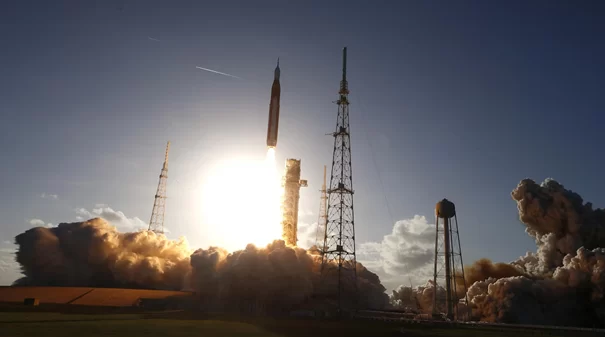
Photo: Reuters / Joe Skipper