Guest contributor: Sarah Brooks
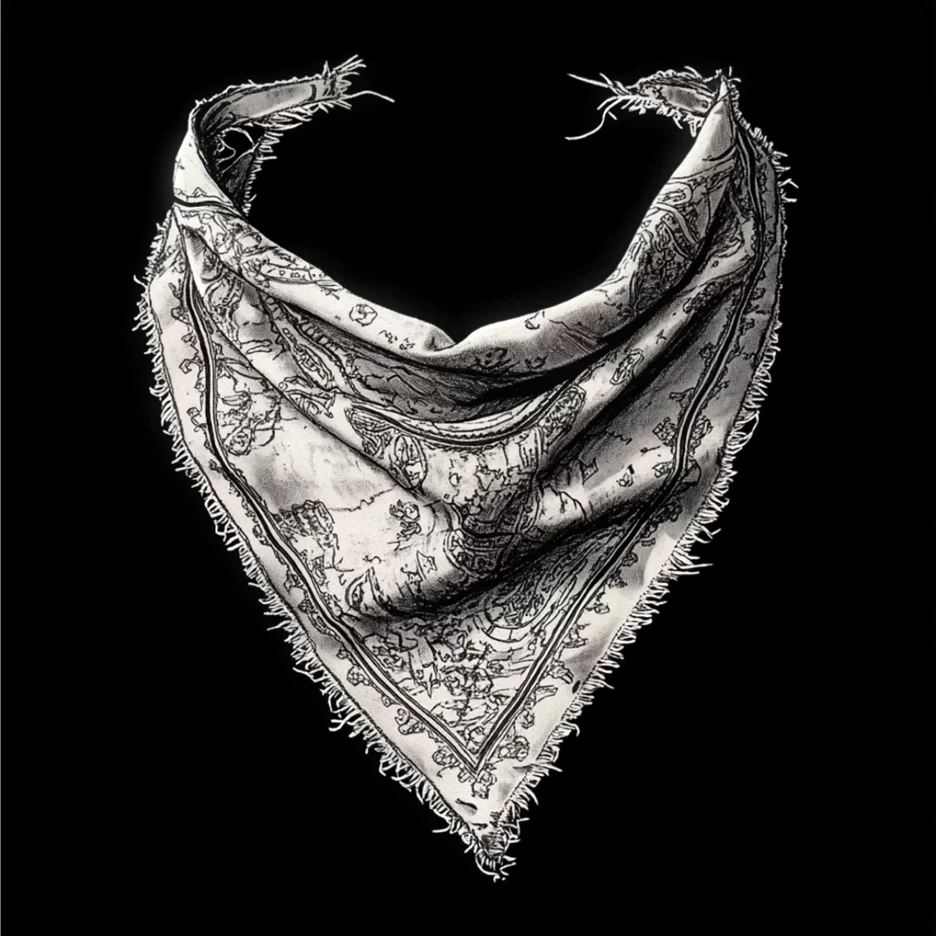
2074 Community Bazaar haul, obtained by barter
This morning, I moved through the makeshift community bazaar with a cup of coffee in hand. Real coffee, from the thinning yields grown in the highlands two valleys over, and traded here in paper bags for whatever people have to offer. It warmed me in the morning chill. The bazaar stalls were arranged under a patchwork of shade structures, neighbors spread their things on tables and blankets: hand tools, seed packets, repaired electronics, and cloth. The air smelled of woodsmoke, the sharp pine resin, and the green scents of wild onion and ramp.
The flow of people and goods carried me along. I stopped at a table of old clothes, arranged in loose groupings by someone who had taken care with them. Among them was a bandana. I picked it up. It was nostalgic to hold a piece of fabric meant for the body as is, with only its cotton properties: softness against the skin, a buffer against a cool breeze, protection from the sun, dust, and sweat. All our fabrics are now blended with nanotechnology and thermochromic coatings, letting us regulate our body temperature as conditions shift. The temperatures of our days swing wildly, thirty degrees or more between sunrise and sunset, and having the right garment is a matter of health and even survival.
The bandana’s once-bright red had faded to a light grey. I looked more closely at the patterns of words and printed images. It was a commemoration of Hurricane Helene, which struck Toogeyi (Asheville) in 2024. By then, the Cherokee name had been in active reclamation for decades. Now, fifty years on, Toogeyi is what most people say first. I read the words around its perimeter, set among images of Appalachian Mountain peaks, wildlife, and scenery from Pisgah National Forest: Aniyvwiya: Strong. And Udeligv: Rebuild.
My grandparents had told me about the hurricane and how it had destroyed homes and businesses in their community. When they described it, it seemed so long ago. But holding this cloth, I felt the distance collapse, and I wondered who had worn this garment originally. The bandana has always been a symbol of community pride and resilience. Its meaning has only deepened in the decades since Helene. In the aftermath of that storm, the old infrastructure failed. People were left to find their own way. Our community’s lifeways then began to be heard differently, their knowledge sought after for lessons, not as artifacts or displays of long-gone heritage.
The understanding of how to live in a reciprocal relationship with a watershed, how to read a forest, and how to build with the land rather than on top of it was kept alive through generations. Parents and grandparents taught their children the language, ceremonies, and responsibilities, even as the broader culture worked steadily to erase them. That work, sustained over more than a century of pressure, became the foundation that Toogeyi rebuilt on. Now the rivers are named again in Cherokee. The building practices follow the ridgelines. The food systems root downward into the soil instead of importing goods from thousands of miles away. What was once called alternative is now simply how things are done.
The woman who sold the bandana to me looked to be in her forties, about 20 years older than me. She didn’t know the story of it, she said. She had found it at another bazaar, years ago, and kept it because it felt important. I felt that, too. Whatever its origin, I feel it belongs here with me. It’s a thing that has likely passed through many hands to arrive in mine. It carries both a commemoration of catastrophe and the stubborn insistence of survival stitched into the cloth. It reminds me of the cycles of culture, nature, and time, and the constant re-writing of futures. For our peoples and for all peoples.
Udeligv. Rebuild.
About Sarah Brooks

I am a multidisciplinary designer, writer, and inner world explorer dedicated to creating provocative artifacts and stories about possible regenerative futures. I have led teams through change and innovation across public and private sectors and taught at leading design programs. My work is rooted in living systems and the belief that imagination and intuition are essential tools for shaping what comes next.
Links: