Welcome to another posting of student work from “Alternative Perspectives.” The class was a popular one and, in my view, the quality of work was so great, that it makes sense to share with the foresight community. It should be noted that presentation slides don’t do justice to the live discussions, but they give you a sense of the work our students do.
Up next is Heather Schlegel and “Toward a Clarification of Terms.” Since Heather just shared this presentation at APF’s “Play” Gathering in Orlando over the weekend, so it seems apropos. Heather reviewed Ruud Van Der Helm’s 2006 piece, “Towards a clarification of probability, possibility and plausibility: how semantics could help futures practice to improve,” foresight 8 (3), pp. 17-27. She noted that the piece points out how futurists often use these terms differently, which can create confusion for clients, and agreed with van der Helm’s attempts to define them more precisely.
Enjoy Heather’s take, and feel free to comment. Andy Hines
In November of 2012, Houston voters approved a bond of $1.89 billion to replace and repair 40 schools across HISD. The new and renovated schools should last for decades, and in order to fully serve future generations of students, HISD has turned to Dr. Bishop to help them imagine schools of the future. Dr. Bishop was recently interviewed for KUHF FM on his role in helping Houston ISD with this massive undertaking.
Check out the KUHF piece here.
Shell’s New Lens Scenarios mark the company’s 40th year of working with scenarios that anticipate the future. Their newest set of scenarios seek to consider what the world may look like in the year 2100. In honor of their 40th year of crafting scenarios, it would be worthwhile to review just what Shell anticipates for the future.
According to Shell, “The world in the future will be defined by how people and governments meet the challenges posed by institutions, inequality, and insecurity in relation to the paradoxes of prosperity, leadership, and connectivity.” Keeping this statement in mind, New Lens uses two very different scenarios to explore the future: Mountains, and Oceans.
In “Mountains”, Shell sees a world where those in power seek to maintain and promote the status quo. Economic development is moderate, while environmental and energy policy transforms our global transportation network to create cities that are more compact. Shell sees natural gas as the foundation for the world’s energy, with demand in oil peaking around the year 2035. Towards the end of the century hydrogen and electricity will be the energy source of choice to run automobiles.
Shell sees the world not achieving the goal of limiting global warming by 2°C, despite a decline in green house gas emissions beginning after 2030.
In “Oceans”, influence and power are more diffused. The world is more prosperous, but also more volatile. Market forces and society shape the world’s energy system, much more than government policy. Both oil and coal continue to play a major role, while natural gas and nuclear power, hampered by public resistance, slow technology adoption, and policy inertia, experiences limited growth. High energy prices and demand cause oil resources to be developed in hard to reach places, but demand plateaus around 2040. In the 2060s, solar becomes the largest primary source of energy, spurred on by the high prices which helped to encourage increased efficiency.
Shell’s glimpses into the future are intriguing, and Shell certainly puts much rigor into New Lens. Their outlook on the balance of power is very interesting, though there are a few things left that need resolution. Both shifts to alternative energy sources take place after peaks in demand. In making the transition to the next energy source in both scenarios, one can wonder how that transition will play out in the energy markets. Another observation is that presenting only two visions of the future, over a very long time horizon and with a very broad remit, seem a little limiting. The future may turn out to be more pluralistic than two scenarios on their own suggest.
In the end, 40 years of exploring the future is very admirable. Shell has set an example for other companies to follow in their ongoing efforts of studying the future. While there are some minor issues with the New Lens scenarios, both Mountains and Oceans present interesting views of the future and equally interesting implications. As a Futurist, but more importantly as a human being, I wonder which of these two futures we shall actually enjoy?
Looking for an awesome futures course to take this summer? Join Dr. Cindy Frewen of and Professor Grag Van Alstyne for Design Futures, a course that combines design thinking and futures studies. The course will be held in jointly with OCAD University in Ontario and at UH here in Houston.
Information session to be held on May 16th 5:30 PM CDT.
From Dr. Peter Bishop:
Colleagues,
“All good things must come to an end.” So it is with my full-time appointment to teach in and support the futures program at the University of Houston. I have submitted my letter of resignation to the Dean, and he accepted it at a faculty meeting on Tuesday.
It has been just over 30 years since Oliver Markley allowed me to sit in on his forecasting class to learn how to teach futures studies (and where I met my wife of 30 years!). It’s been 25 years since Chris Dede invited me to teach three-day futures courses at IBM plants around the country. It has been 8 years since we moved the program from UH-Clear Lake to the College of Technology at the University of Houston. And whole lot more has happened in between– too much to describe.
But it is time to retire and turn the program over to someone who has more life left, and in many ways more talent, than I have. It’s called succession planning. We futurists are supposed to be good at that! And most of all, if our plan works out, I am most grateful that our program will be in excellent hands for many years to come.
So what of me? Frankly not as much change as you might expect. The Dean has asked me to stay on part-time to teach a few courses, manage our Certificate program, and generally represent the University and the program as I have always done. With a slightly reduced teaching load, my conscience will finally force me to push out those papers that have been hanging fire for years.
I am also still passionate about promoting futures thinking for the “rest of education.” My vision is that we teach as much about the future, to all students, as we teach about the past. And I am collaborating with other foresight programs around the world to define a common core of what we teach to improve ourselves and to guide those who would like to start new programs.
So, as I’ve said to my colleagues at the University, “You’re not rid of me yet!” And most of all, it is still a privilege and a pleasure to know and work with you all to build a new profession and a new academic discipline for the benefit of future generations…
Dr. Oliver Markley has been kind enough to post an edited audio version of his presentation for our April 13 Designing Urban Futures gathering here. Don’t forget the accompanying slideshow, and check out the rest of that day’s presentations at our Houston Futures community page!
A prospective student raised a question about specialization in foresight in a recent APF listserve conversation. This question is also a frequent one of our Houston Futures grad students. We discussed the question recently in Pro Seminar and did a ”personal branding” exercise to help us think through how we want to present ourselves to the marketplace in doing our foresight work (see “The Personal Brand in Futures“ for additional thoughts) .
There is no “right” answer, of course. It depends on the individual and their circumstances and capabilities. First, to clarify terms. Generalist refers to one who works on a wide range of foresight topic and use a range of tools. I would put myself in that category, having seemingly worked on the future of almost everything over the last 20+ years. Specialist refers to one who picks a particular domain or topical interest, and becomes an expert in it, along the lines of an “energy futurist,” “transportation futurist,” “legal futurist,” etc. It may also be possible to be a “single method” futurist and brand your expertise in say, doing a particular type of scenario technique, or perhaps being expert simulations and gaming. I haven’t seen much of this, but is seems plausible. For instance, when I think of CLA (causal layered analysis), I think of Sohail.
And, of course, there are hybrid versions. Mostly generalist with some specialization. In my case, for instance, I’ve done so much work on consumer insight and values that I know present that as a specialization. I suspect, over time, that many generalists find this happening. Or you start as a specialist and gradually expand into new areas.
For students, though, is there a better way? One clue might be whether the student already has a subject matter expertise and can then futurize it. It may be that an undergrad major or work experience provides the foundation for specialization. It is probably a bit easier to break into professional foresight with a specialization, as it addresses the credibility question. It’s perhaps tougher to break in as a generalist, unless you are willing to pay your dues and start at the bottom. These are the days of entry-level research assistant that I remember, hmm, somewhat fondly.
It also helpful to take stock of what makes you happy. Would you be okay being narrowly focused, perhaps going over the same ground, giving the same talk, again and again? Or do you live for the challenge of always breaking new ground – and being okay with the risk that you’re going to miss something obvious in an area new to you (every generalist’s nightmare)?
It depends, but knowing yourself and your anticipated brand can help you point you in the desired direction, and, of course, we can always change. Andy Hines
Dr. Bishop caught Phil Gyford (’00) on CBC’s Spark program on Sunday, Apr 14. Phil was being interviewed about data longevity and ephemerality, that some data does not stay on the web as long as people might think. One way that data disappears is when large corporations, like Google or Yahoo, purchase sites that are supported by user-content. These are called ‘aqui-hires’ in which the purchaser is more interested in hiring the staff than in using the technology or the content. The focus for this segment was Posterous, a free blogging site that included something like 9 million blogs. Turns out that Phil has been monitoring this phenomenon on his website called Our Incredible Journey. He got the name from the traditional sign-off by the website going away, thanking people for participating in “our incredible journey.” Phil has been monitoring trends for a long-time. He was a sort of ϋber scanner when he was in the program. Dr. Bishop remembers the night that Phil told the class about a new service called Napster, a full six-months before it hit the news media.
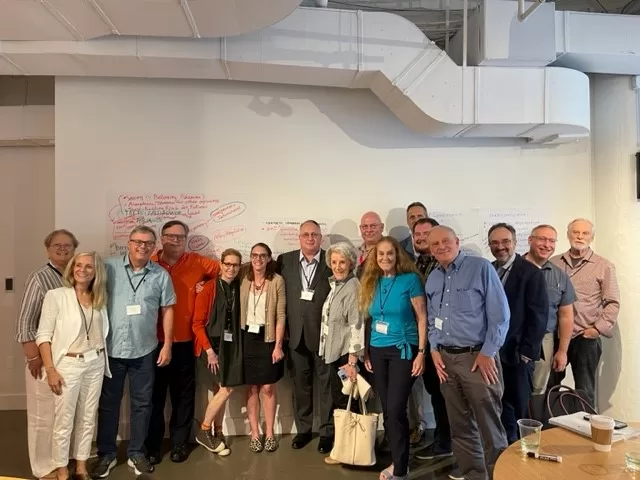
Saturday, April 13 the University of Houston’s Futurists hosted the meeting City Making in the 21st Century: Designing Urban Futures. We had an amazing turn out of about 40 attendees.
The day began with Dr. Oliver Markley, Professor Emeritus, presenting Alternative Images on the Future of Cities. Introduced as an intuitive futurist, Dr. Markley took us through Five Aspirational Futures Scenarios and then led the group in a session of “remote viewing” via mental time travel the possible/plausible alternative futures.
Following Dr. Markley, Todd Gentzel, Chief Strategist at Yaffe Deutser, presented Psychology and the Field of the Future . He explained how the psychology of identity, personal orientation within cities, and perception of time all play into an individual’s acceptance and understanding of futures, ultimately impacting the development of cities in the future.
Then Rives Taylor, Director of Sustainable Design at Gensler, stepped in to discuss Lessons from Houston: Infrastructure of a Resilient City. His presentation brought to light that Houston could design itself, using nature as an example, to become a more resilient city by better utilizing of all of the rainfall we receive.
Our final presenter, Dr. Cindy Frewen of the APF and adjunct professor extraordinaire, spoke of Great Urban Divides. The informal housing being built by vulnerable populations is drastically increasing, and within urban centers, the traditional geographic divides between the types of informal communities is disappearing. We may now be facing urban regions rather than urban cities.
Then afternoon was devoted to break out sessions, where small groups discussed issues proposed by individual attendees. Topics ranged from the most far out scenarios you’ve ever encountered, to practical problems faced by futurists (planning vs. preparation, dealing with challenging clients, how to engage people in futures), to, naturally, futures (the legal framework of robocars, how to deal with jails when we run out of money).
Overall the meeting was a rousing success. Thanks to Dr. Bishop, Dr. Hines, Dr. Frewen and all our guest speakers for an unforgettable day! Check out all the tweets.
It’s been great to hear growing interest in developing the field and profession of _______, um, what do you call it?

I looked at this question in my dissertation and found it has received intermittent attention over the years (Cornish, 1977; Horton, 1999; Becker, 2002; Schwarz, 2005; Amsteus, 2008; Sardar, 2010; Masini, 2010; Marien, 2010; Tonn, 2010; Rohrbeck, 2011). The pattern seems to be one of (a) flurry of activity (b) inability to achieve consensus (c) long quiet period, (d) repeat.
One phenomenon I’ve noticed in that last 10 years at APF, which has an active listserv for conversations, is that when this or related questions about the field/profession get raised, two things happen: (1) someone inevitably points out that it’s all been talked about before (2) others suggest it’s not really relevant anyway — and the conversation quickly dies out. Thus, in my experience we’ve actually talked about it very little – and this is a professional association!
I think these are critical questions for those of us interested in building the field and the profession (and fair enough, not all of us are). I suspect that if we simply try to have the conversations again spontaneously, we’ll repeat the cycle above. What I’m thinking is that we first need to figure out a strategy for how to work through these issues before we dive in again. Does that make sense? I think we can do it, but it won’t be easy.
Full disclosure: “Foresight” is my preference. Andy Hines
References
Amsteus, M. (2008) Managerial foresight: concept and measurement. foresight, 10 (1), pp.53-66.
Becker, P. (2002, October) Corporate foresight in Europe: a first overview. Working Paper. Institute for Science and Technology Studies, University of Bielefeld, Germany.
Cornish, E. (1977) The study of the future: an introduction to the art and science of understanding and shaping tomorrow’s world. Bethesda, MD, World Future Society.
Horton, A. (1999) A simple guide to successful foresight. foresight, 1 (1), pp. 5-9.
Masini, E.B. (2010) The past and the possible futures of futures studies: Some thoughts on Ziauddin Sardar’s ‘the namesake.’ Futures, 42 (3), pp.185-189.
Marien, M. (2010) Futures-thinking and identity: why ‘‘Futures Studies’’ is not a field, discipline, or discourse: a response to Ziauddin Sardar’s ‘the namesake. Futures, 42 (3) pp. 190–194.
Rohrbeck, R. & Gemünden, H. (2011) Corporate foresight: Its three roles in enhancing the innovation capacity of a firm. Technological Forecasting and Social Change, 78 (2), pp. 231-243.
Sardar, Z. (2010) The Namesake: Futures; futures studies; futurology; futuristic; Foresight — What’s in a name? Futures, 42 (3), pp. 177–184.
Schwarz, J. (2005, Fall) Linking strategic issue management to futures studies. Futures Research Quarterly, pp. 39-55.
Tonn, B. (2010) What’s in a name: reflections on Ziauddin Sardar’s ‘the namesake.’ Futures, 42 (3), pp.195-198.